
Climate Change

After a decade of denial and delay, Australia finally has a Federal Government that is taking action on climate change.

Our Powering Australia policy is driving down emissions by:

  • Legislating our emissions reduction targets of 43% by 2030 and Net-Zero by 2050.
  • Creating tens of thousands of jobs and apprenticeships in renewable energy production.
  • Connecting regional renewable energy projects to the national grid.
  • Making electric vehicles cheaper for Australian consumers.
  • Building 400 community batteries and 85 solar banks to connect more Australian households to renewable energy.
  • Ensuring the APS reaches net-zero by 2030, setting an example for the rest of the country.
  • Using the Safeguard Mechanism to drive down emissions from the biggest polluters.
  • Investing in agricultural solutions and carbon farming.
  • Establishing a real-world vehicle fuel testing program to inform consumer choice.


Under Labor's Powering Australia plan, power prices will fall, 600,000 jobs will be created and emissions will plummet. Labor is ensuring that Australia becomes a renewable energy superpower. 


You can see the details of these plans below. 

LEGISLATING NET ZERO

43% REDUCTION BY 2030; NET ZERO BY 2050

Legislating Net Zero

Labor Powering Australia climate change plan is a suite of policies designed to reduce emissions by boosting renewable energy and creating 604,000 jobs.

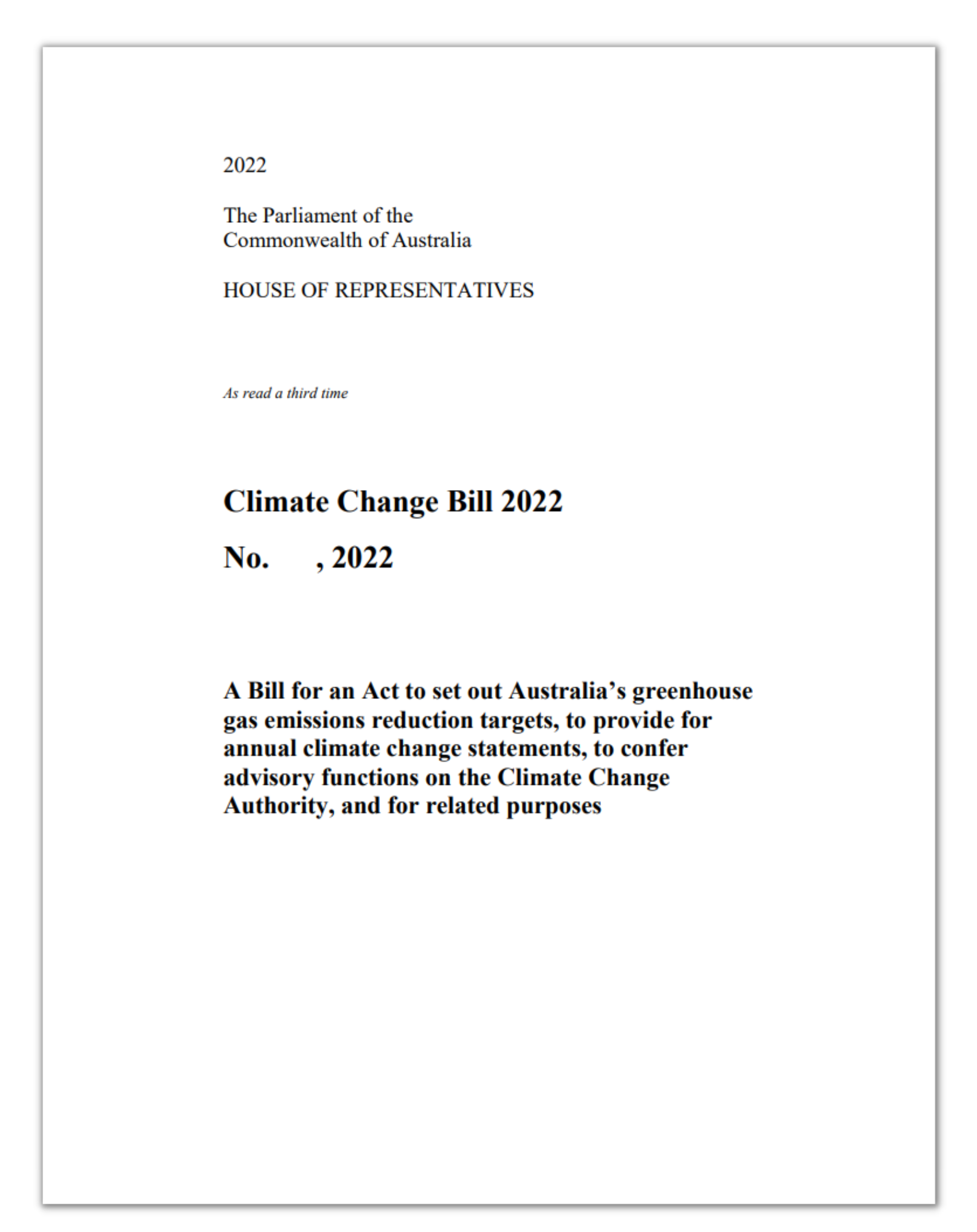
Included in Powering Australia was our goal of a 2030 emissions reduction target of 43% on 2005 levels. The Government’s Climate Change Bill 2022 will deliver on our election commitment to reduce Australia’s greenhouse gas emissions.

This 43% is the modelled impact of our policies and is reflected in this legislation. The legislation is not necessary to update Australia’s target, which the Albanese Government has already done with the UN, or to deliver Powering Australia.

But enshrining the target in legislation is best practice to deliver the certainty Australia needs after 10 years of chaos, which is why peak business, community, environmental and union groups all support the move.

The legislation has four key elements, it:

  • Enshrines in law our Nationally Determined Contribution of 43% emissions reduction by 2030 and net zero emissions by 2050
  • Tasks the independent Climate Change Authority to provide advice on Australia’s progress against these targets, and to advise on new targets under the Paris Agreement which will include a 2035 target;
  • Requires the Minister for Climate Change to report annually to Parliament on progress in meeting our targets; and
  • Embeds the nation’s targets in the objectives and functions of a range of key government agencies including ARENA, CEFC, Infrastructure Australia and the NAIF.

After a decade of denial and delay from the Abbott/Turnbull/Morrison Government, we now have an opportunity to seize the jobs opportunities from a renewable economy, support the transformation of the regions that have always powered Australia, and put downward pressure on energy prices with affordable renewables, all while reducing emissions.

The Australian people voted to end the climate and energy wars; legislating net zero gives the Australian Parliament the opportunity to do the same.

You can read the bill here.

REWIRING THE NATION

Rewiring the Nation

More Jobs, Lower Power Prices

The Albanese Labor Government will rewire the nation to drive down power prices, give our economy a boost of up to $40 billion and create thousands of new jobs – particularly in regional areas.

Australia should be a renewable energy superpower, but our electricity transmission system is desperately outdated.

It doesn’t properly integrate the full capacity of the growing renewables sector, let alone unlock its potential.

Labor’s Rewiring the Nation will invest $20 billion to rebuild and modernise the grid, in line with a blueprint already completed by the Australian Energy Market Operator and signed off by all governments.

Modernising the grid will provide thousands of new construction jobs for Australians, many of those in our regions.

It will revitalise traditional industries like steel and aluminium and allow growth in new sectors like hydrogen and battery production.

Fixing transmission is technology neutral and will allow the market to drive least cost, reliable new energy production.

By working with the Clean Energy Finance Corporation (CEFC) and keeping it in public hands as a government-owned entity, Labor will ensure the grid is rebuilt at the best price possible.

The CEFC will partner with industry and provide low cost finance to build the Integrated System Plan. The end result will be cheaper electricity prices for homes and businesses.

The Labor Government will ensure Australia’s modern energy grid will be built by Australian workers using Australian suppliers by mandating local supply and local labour.

The 2023-24 budget shows that more than half of funding under the Rewiring the Nation program has been allocated to projects. These include the KerangLink between NSW and Victoria, and the Marinus Link between Victoria and Tasmania. 

Only Labor will build an electricity network designed for this century – one which accounts for the rise of renewables as the cheapest new energy source, and links them up to the grid.

NEW ENERGY APPRENTICESHIPS

Labor's New Energy Apprenticeships

The world’s climate emergency should be Australia’s jobs opportunity.

As our trading partners embrace net zero emissions, Australia should be harnessing our natural resources and the skills and innovation of Australian workers to become a new energy superpower. But instead of delivering secure jobs for Australians, the Liberals wasted eight years worrying about their own jobs and bickering over 22 climate policies.

The Clean Energy Council highlights that Australia already faces renewable energy skills challenges, with “difficulties recruiting workers with relevant experience [...] and existing training systems not meeting industry needs”. For example, some training companies do not offer new energy training courses because they are expensive to deliver.

Three in four solar companies now say they have difficulty recruiting electricians, with “not enough candidates with specific experience in renewable energy” the leading barrier.

Despite this skills crisis, and almost $100 billion of new spending, there are still 150,000 fewer apprentices than when Labor was last in government.

Australia now has a Government that understands that new energy can create secure jobs in our suburbs and regions


The Albanese Labor Government is investing $100 million to support 10,000 New Energy Apprenticeships

To encourage apprentices to train in the new energy jobs of the future, and to provide the additional support they need to complete their training, the Albanese Labor Government will invest $100 million to support 10,000 New Energy Apprenticeships.

Apprentices who choose to train in new energy industries will receive up to $10,000 - $2,000 on commencement, and $2,000 a year for up to four years afterwards, including on successful completion. This will help to increase apprentice uptake, boost retention and improve completions.

Examples of eligible industries include rooftop solar installation and maintenance, large-scale renewable projects, energy efficiency upgrades to homes and businesses, green hydrogen, renewable manufacturing, and relevant agricultural activities.

10,000 New Energy Apprenticeships will be available over four years (2,500 commencements a year from 2022-23).


The Labor Government is also investing $10 million in a New Energy Skills Program

Eight years of cuts to TAFE have severely reduced the availability of relevant training pathways for new skills, particularly those that are not yet in the market at scale, or for experienced workers seeking to re-train or upskill in new energy industries.

To tailor skills training to the specific needs of new energy industries, Labor will also invest $10 million in a New Energy Skills Program.

Under the Program, Labor will work with the states and territories, industry and unions to ensure workers have access to training pathways that are fit-for-purpose.

This initiative will boost existing work by the TAFE sector to develop skills and build workforce capability.

As part of the Program, Labor will also develop a mentoring program in which experienced workers in new energy industries help to train and support new apprentices.


Further work

These commitments are a down payment on Labor’s broader policies to reverse the Liberals’ damage to TAFE and training, and to ensure the workers and communities who have powered Australia for decades continue to do so.

The Labor Government will also work with industry, unions and regulators to ensure that new energy jobs are secure, with good pay and conditions.

Labor welcomes industry’s recognition that it needs to do more to become an employer of choice and Labor will work with the industry to deliver that outcome.

ELECTRIC CAR DISCOUNT

Electric Car Discount

Australia lags the world on take up of electric cars.

Just 0.7 per cent of cars sold here are electric – compared to a global average of 4.2 per cent, 11 per cent in the United Kingdom and the European Union, and 75 per cent in Norway.

In total, there are just 20,000 registered electric cars on Australian roads, of around 15 million total cars.

This is despite growing enthusiasm for electric cars in Australia. A majority of Australians say they’d consider buying an electric model as their next car.

But electric cars remain unaffordable for most Australians.

There are no electric cars available in Australia for under $40,000, and just five for under $60,000.

In comparison, there are more than two dozen electric cars available in the UK for under AU$60,000 – including eight that are cheaper than the cheapest electric car in Australia.

This is because the UK Government, and governments around the world, have introduced incentives and policies to help electric cars compete with older technology with lower upfront costs.

Passenger cars make up almost 10 per cent of Australia’s CO2 emissions. It’s imperative we begin to change that.


What is Labor doing about it?

The Labor Government will introduce an Electric Car Discount – to make electric cars cheaper so that more families who want them can afford them, and to reduce emissions.

As part of the Discount, Labor will exempt many electric cars from:

  • Import tariffs – a 5 per cent tax on some imported electric cars; and
  • Fringe benefits tax – a 47 per cent tax on electric cars that are provided through work for private use.

These exemptions will be available to all electric cars below the luxury car tax threshold for fuel efficient vehicles ($77,565 in 2020-21).

This cut-off will encourage car manufacturers to import and supply more affordable electric models in Australia.

To support the Electric Car Discount, the Labor Government will also:

  • Work with industry, unions, states and consumers to develop Australia’s first National Electric Vehicle Strategy, including consideration of:
    • Further measures to increase electric car sales and infrastructure;
    • Policy settings to encourage Australian manufacturing of electric car components (especially batteries) and possibly cars themselves; and
    • Ways to address the policy implications of declining fuel excise;
  • Consider how the Commonwealth’s existing investment in infrastructure can be leveraged to increase charging stations across the country; and
  • Consider how other existing Commonwealth investments, including in its fleet, property and leases, can also be leveraged.


How will Australians benefit?

The Electric Vehicle Council estimates that a $50,000 model (such as the Nissan Leaf) will be more than $2,000 cheaper as a result of removing the import tariff.

If a $50,000 model is provided through employment arrangements, Labor’s fringe benefits tax exemption will save employers up to $9,000 a year. Often FBT is passed on to employees – and those employees will benefit directly from Labor’s policy.

Savings will be even higher for more expensive models (up to the luxury car tax threshold).

Electric cars are also cheaper to run and maintain. For example, Nissan estimates that a commuter in NSW can save $30 a week by switching from a petrol car to its Leaf model.


When will it begin? How much will it cost?

Labor’s Electric Car Discount began on 1 July 2022 and be reviewed after three years, in light of electric car take up at that time.

These incentives will cost around $200 million over three years.

POWER TO THE PEOPLE

Power to the People

Community Batteries for Household Solar

Australia is perfect for rooftop solar, with more than 1 in 5 Australian households already joining the solar revolution.

That’s the highest uptake in the world. But just 1 in 60 households have battery storage – because the upfront costs are still just too high.

The Albanese Labor Government is fixing that for up to 100,000 Australian households, by installing 400 community batteries across the country.

It’s a $200 million investment to cut power bills, cut emissions and reduce pressure on the electricity grid.

And it will allow households that can’t install solar – like apartment owners and renters – to draw from excess electricity stored in community batteries.

Successful applicants for the $29m program administered by Business Grants Hub to deliver a subset of the 400 batteries (Streams 1 & 2) have been announced as of May 30th, 2023. This includes 52 batteries to be placed in 58 of the eligible locations contained in the initial funding streams.

Increasing battery storage across the country is vital to taking full advantage of cheap solar energy.

What is a community battery?

A community battery is typically the size of a 4WD vehicle, and provides around 500kWH of storage that can support up to 250 local households.

Solar households will feed into the battery during the day and draw from the stored energy at night.

Any excess electricity stored in a community battery above local community needs can be sold into the grid when it is needed most – in the early evenings – putting further downward pressure on electricity bills.

While models will be tailored to local needs, community batteries will be funded by the Commonwealth, installed by licensed electricians, and operated by network operators.

Once a battery is installed in a community, providers will invite local households to participate – just like they offer solar and battery schemes now.

It just makes good sense to share a single community battery among up to 250 households instead of expecting every household to pay for the purchase, installation and maintenance of their own battery.

Community battery benefits

Solar households without batteries have to rely on the electricity grid when the sun isn’t shining. Increasing battery storage will:

  • Cut power bills for households – by taking advantage of inexpensive solar energy that can be stored and used at peak times;
  • Cut emissions - by increasing the total use of renewable energy; and
  • Reduce pressure on the grid – by reducing community reliance on the grid at peak times when the sun isn’t shining.

The Australian Energy Market Commission recently flagged a rule change that would charge solar households for feeding energy into the grid.

This proposed rule change highlights the community-wide need for household solar to be supported by battery storage.

Community batteries offer greater economies of scale than household batteries, with lower capital, installation and maintenance costs.

Community batteries also store and distribute electricity more efficiently, by allowing excess solar power to be shared (for example when families are on holidays, or with households unable to install solar).

Community batteries are being rolled out in various locations around Australia. Labor’s support will accelerate the rollout to the benefit of households and the environment.

While grid-scale batteries will play a critical role in our energy future, they don’t allow individual households to directly store and draw from their own solar power.

NATIONAL RECONSTRUCTION FUND

National Reconstruction Fund

The Albanese Labor Government will establish a National Reconstruction Fund, to create secure jobs for Australian workers, drive regional economic development, boost our sovereign capability and diversify the nation’s economy.

The COVID pandemic has exposed serious deficiencies in Australia’s economy, in particular our ability to manufacture products and be globally competitive when it comes to innovation and technology.

Building new industries and boosting our existing industries represents an opportunity for Australia to recover from the COVID pandemic with a stronger economy. After 8 long years of policy drift presided over by consecutive Liberal leaders, this country now has a government with a vision to put the country back on a road to prosperity.

Labor’s National Reconstruction Fund will allocate $15 billion to partner with the private sector, including superannuation funds, to support investments which demonstrate they will grow the economy and increase employment.

From commercialising our historic capacity in science and innovation to boosting the development of medical devices and pharmaceuticals, through to reviving our capability to make cars, trains and ships, the National Reconstruction Fund will support the businesses in these industries to secure the capital and investment to grow and prosper.

Australia must be a country that makes things, to have our own industrial and manufacturing capabilities.

If there is anything that COVID has taught us, it is the need for Australia to be a place which makes things – to have our own industrial and manufacturing capabilities – our own sovereign capabilities.

This will build on Labor’s Future Made in Australia agenda to invest in Australia and Australian workers.

The Fund will be legislated and be governed by an independent Board using the successful model which Labor created through the Clean Energy Finance Corporation.

It will provide $15 billion of investment through a combination of loans, equity, co-investment and guarantees. The Fund will be administered on the basis that it will achieve a return to cover borrowing costs, with an expected positive underlying cash impact.

Labor’s plan to unlock investment opportunities is the first part of our comprehensive plan of our national reconstruction agenda.

Australians have a government that is on their side.

National Reconstruction Fund Investment Mandate

On 30th November, 2023 the Minister for Industry, Ed Husic and Minister for Finance, Katy Gallagher announced the National Reconstruction Fund's investment mandate. The mandate sets out clear expectations for the NRF Corporation including areas for investment across seven key priorities (renewables and low emission technologies; medical science; transport; value-add in agriculture, forestry and fisheries; value-add in resources; defence capabilities and enabling technologies).

The mandate requires the Corporation to target a rate of return of between 2 and 3 per cent above the five-year Australian Government bond rate over the medium to long term.

The NRF Board will make independent decisions to provide finance, including debt and equity, to Australian-based investments in seven priority areas of the Australian economy.

More information

The National Reconstruction Fund is the first step in Labor’s plan to rebuild Australia’s industrial base.

Australia has suffered nearly a decade of policy drift since the Liberal’s goaded the car industry to leave. We rank dead last in the OECD when it comes to manufacturing self-sufficiency.

We need to revive our ability to make world-class products and, in the process, create secure well-paid jobs for Australians.

The National Reconstruction Fund provides a crucial financing vehicle to specifically drive investment in projects that will build prosperity across the country, broadening our industrial base and boosting regional economic development.

The $15 billion in capital provided through the National Reconstruction Fund will support projects that create secure well-paid jobs, drive regional development, and invest in our national sovereign capability, broadening and diversifying Australia’s economy.

Through the National Reconstruction Fund, Labor will partner with businesses to unlock further potential private investment of more than $30 billion1. Like the CEFC, the Fund would operate in a way that is expected to make a return to the budget bottom line.

This investment will play to our strengths supporting new and emerging industries, transitioning existing industries to net zero emissions and by making it easier for people to commercialise innovation and technology.

The National Reconstruction Fund will be legislated to demonstrate our commitment to delivering a $15 billion capital injection into Australia’s prosperity giving business certainty for the life of projects.

The mission of the National Reconstruction Fund is to:

  • create secure well-paid jobs
  • build on our national strengths
  • diversify Australia’s industrial base
  • develop our national sovereign capability
  • drive regional economic diversification and development

The National Reconstruction Fund will be administered by an independent board with government setting its mandate to drive investment in key sectors focusing on value adding and capability development to leverage Australia’s natural and competitive strengths including:

  • Value add in resources. Expand our mining science technology, ensure a greater share of the raw materials we extract are processed here, for example, high purity alumina from red mud in bauxite processing or lithium processing for batteries.
  • Value add in the agriculture, forestry and fisheries sectors. Ensure we unlock potential and value add to our raw materials in sectors like food processing, and textiles, clothing and footwear manufacturing.
  • Transport. Develop our capabilities in car, train and shipbuilding supply chains.
  • Medical science. Fulfil our potential, given our world leading research, in providing essential supplies such as medical devices, and Personal Protective Equipment (PPE), medicines and vaccines.
  • Renewables and low emission technologies. Pursue commercial opportunities from; components for wind turbines; production of batteries and solar panels; new livestock feed to reducing methane emissions modernising steel and aluminium; hydrogen electrolysers, and innovative packaging solutions for waste reduction.
  • Defence capability. maximise our requirements being sourced from Australian suppliers employing Australian workers, whether they be technology, infrastructure or skills, complimenting Labor’s Defence Industry Development Strategy.
  • Enabling capabilities. Supporting key enabling capabilities across engineering, data science, software development including FinTech, EdTech, AI and robotics.

National reconstruction must include a focus on regional development. Ensuring our regions are able to sustain secure well-paid jobs and building are broader industrial base in key areas is a focus of the National Reconstruction Fund.

Labor’s national reconstruction agenda will include wide-ranging consultation with communities, businesses and unions on how we build a more prosperous Australia.

Projects eligible for the National Reconstruction Fund will also benefit from Labor’s National Rail Manufacturing Plan, the Defence Industry Development Strategy and Rewiring the Nation which prioritise domestic procurement.

In accordance with Labor’s Secure Australian Jobs Plan, the Fund will only enter into financial arrangements with businesses and organisations that are providers of secure jobs.

SOLAR BANK

Solar Banks

Labor is investing $100 million to deliver an initial 85 solar banks around Australia, giving over 25,000 households that are unable to install rooftop solar, access to cheaper energy.

The success of this initiative will spark additional private investment to deliver solar to even more homes.

One in four Australian households now have rooftop solar.

This uptake is truly remarkable, and a credit to families and households across the country.

It’s the kind of proud national achievement that’s possible when technology enabling policy – like Powering Australia - is implemented by a government with ambition and vision.

Unfortunately 1 in 3 Australians are ‘locked out’ of rooftop solar, unable to install panels and reap the benefits of cleaner, cheaper energy in their household bills.

This includes renters, apartment-dwellers, people who can’t afford upfront solar costs, and those whose homes just aren’t compatible.

Community solar banks, allowing those locked out of the market to access solar energy, have been popping up around the world and meeting this challenge for over a decade, including in over 40 U.S. states.

An ARENA funded UTS study said they were both ‘feasible and desirable’ in the Australian context.

Labor’s investment gives solar banks the kickalong they need, just like Labor’s initiatives like the RET and ARENA set rooftop solar on its remarkable trajectory.

NET-ZERO APS

Net-Zero APS

Under the Albanese Labor Government, the Australian Public Service (excluding security agencies) will commit to a target of net zero emissions by 2030.

Business, states and territories and households have all led the way when it comes to prioritising cleaner and cheaper energy and reducing emissions.

It’s past time the Commonwealth Government did too.

Good governments lead by example, and the public service should always be looking for ways to ensure bang for buck for the taxpayer in their running costs.

Under the previous government, there was a lack of transparency about the Commonwealth Government’s own emissions, but the last available data (2011-2012) indicates non Defence agencies emitted 1.2 million tonnes, a year.

If the Australian Public Service were a company – this 1.2 million tonnes would put it in the top 50 emitters.

The Howard and Rudd-Gillard governments had a bipartisan practice of annual public reporting of Commonwealth emissions.

Labor would restore this practice.

The public service target would be achieved through a mixture of demand reduction, renewable supply, and offset purchases.

This would include a low-emissions vehicle target for the Commonwealth fleet of 75% of new purchases and leases by 2025, which will drive down running costs, and will give a much-needed boost to the non-existent second-hand electric vehicle market in Australia.

The Commonwealth fleet target is in line with the state government policies of New South Wales, Tasmania and South Australia to electrify government passenger vehicle fleets by 2030.

Additionally, Labor’s Buy Australian Plan would apply to future Power Purchasing Agreements entered into by Commonwealth agencies.

Government procurement is a critical tool to drive local jobs and manufacturing instead of boosting Australian industry. An Albanese Labor Government will ensure the public service leads by example, prioritises local content, and secures cheaper, renewable energy for its operations under the Powering Australia Plan.

Security agencies (ADF, ABF, AFP and the Australian Intelligence Community) will be exempt from the Public Service emissions target due to their unique operational needs.

SAFEGUARD MECHANISM

Safeguard Mechanism

Australian businesses know that good climate policy is good economic policy.

After almost a decade of Coalition division and inaction on energy, Australian industry has been advocating for a robust policy framework to maximise future competitiveness, invest in the regions and ensure Australia has the future workforce we need to seize this opportunity.

The Albanese Labor Government is working with industry to create jobs and reduce emissions, as recommended by Australia’s biggest businesses.

Our largest exporters know that global markets are moving to a low-carbon future, with more than 80% of Australian trade now covered by other countries’ net zero commitments.

Major Australian companies are committed to net zero by 2050, and many have made ambitious 2030 pledges.

Australian business now have an active partner in government.

Industry is rightly demanding certainty from government, a policy framework that encourages and rewards their efforts, and a level playing field with their competitors.

Powering Australia delivers the certainty and policy framework that industry has been rightly demanding.

In industry, agriculture and carbon farming:

  • For facilities already covered by the Government’s own Safeguard Mechanism, Powering Australia has adopted the Business Council of Australia’s recommendation that “emission baselines [be] reduced predictably and gradually over time” to “support international competitiveness and economic growth.” These changes provide a supportive policy framework for industry’s own commitment to net zero by 2050.
  • Labor’s Powering the Regions Fund supports innovation by existing industry and the creation of new industries in regional areas to ensure Australia is at the front of the pack in a changing global economy.
  • Investment of up to $3 billion from Labor’s National Reconstruction Fund supports renewables manufacturing and the deployment of low-emissions technologies, broadening Australia’s industrial base and boosting regional economic development.
  • These policy levers also support private investment in abatement – with Labor committing to ensuring integrity and cobenefits from carbon credits.
  • In agriculture, Powering Australia supports the development and commercialisation of emissions-reducing livestock feed, and improve carbon farming opportunities.
  • 10,000 New Energy Apprentices will be trained in the jobs of the future, and a $10 million New Energy Skills Program will work with industry, unions and the states and territories to ensure training pathways are fit-for-purpose.


Safeguard Mechanism

The Safeguard Mechanism was created by then Prime Minister Tony Abbott, and introduced by the Turnbull Coalition Government on 1 July 2016, with support from Scott Morrison as Treasurer.

The then Environment Minister, Greg Hunt declared the intent was to ‘ensure that emissions reduction paid for by the Government [through the ERF] are not displaced by a significant rise in emissions elsewhere in the economy.’

It applies to ‘designated large facilities’ – those whose annual Scope 1 greenhouse gas emissions are more than 100, 000 tonnes of carbon dioxide equivalent.

There are currently 215 facilities covered by the Safeguard.

The Business Council of Australia has been urging the Government to reform the Safeguard Mechanism – to send an ‘investment signal to achieve national emissions targets and budgets out to 2050.’

Big business and industry, as well as their investors know the world is changing, and that they need the right signals in place not just to stay competitive but to innovate and thrive.

Staying competitive and on track for 2050 will also be critical to avoid penalties from carbon border tariffs imposed by other nations and trading partners in the future.

Labor is ambitious for Australia’s future in a changing global economy, and backs Australian industry in the decarbonisation opportunity.


Improving the mechanism

For facilities already covered by the Government’s own Safeguard Mechanism, Powering Australia has adopted the Business Council of Australia’s recommendation that “emission baselines [be] reduced predictably and gradually over time” to “support international competitiveness and economic growth.” These changes will provide a supportive policy framework for industry’s own commitment to net zero by 2050. No additional facilities will be covered.

RepuTex models that these improvements to the Safeguard Mechanism, that support innovation in industry and private demand for carbon credits, will create thousands of jobs by 2030.

An estimated 5 in 6 of these jobs will be in regional Australia.

The BCA’s recommendation is also supported by the Australian Industry Group and experts such as the Grattan Institute and Carbon Market Institute.

It makes sense that Australian businesses and industry groups are pushing for this supportive policy framework. More than 2 in 3 facilities covered by the mechanism have emissions goals in line with, if not more ambitious than, net zero by 2050.

Within a broad trajectory towards net zero by 2050, Labor has asked the Department of Industry and the Clean Energy Regulator (which already administers the scheme) to determine revised baselines for each facility in close consultation with industry. They will carefully consider the available and emerging technologies in each sector.

Labor will provide tailored treatment for emissions-intensive, trade-exposed industries. This will be based on the principle of comparative impact – ensuring that exporters remain competitive, and that emissions do not ‘leak’ overseas.

Labor’s policy will include tradeable credits for companies that stay below their baselines – a promise that the Government has so far failed to deliver.

Credits and revised baselines will encourage investment in low-emissions technology, not raise revenue for government.

Every dollar invested in emissions reduction and offsets will grow our economy and create jobs.

Labor’s Powering the Regions Fund and National Reconstruction Fund will assist covered facilities in meeting their new baselines, and the deployment of low emissions technology across industry more broadly.

The legislation passed both houses of Parliament in May 2023 and included a number of amendments including a hard cap on total emissions covered by the safeguard mechanism and the need for emissions to gradually decline. 

POWERING THE REGIONS FUND

Powering the Regions Fund

The Albanese Labor Government is supporting the decarbonisation of existing industry, as well as the creation of new industry by establishing the Powering the Regions Fund.

The Powering the Regions Fund will keep Australian industry competitive in a changing global economy, and ensure our regions thrive.

The Powering the Regions Fund will be established with uncommitted funding from the Emissions Reduction Fund (ERF)/Climate Solutions Fund (CSF).

This grant funding will continue to purchase ACCUs on behalf of the Commonwealth – but its remit has been expanded to focus on an additional three priorities directly supporting industry:

  • Supporting industry with its decarbonisation priorities, such as energy efficiency improvements and fuel switching (e.g. hydrogen);
  • The development of new clean energy industries, such as green hydrogen production and export, and bioenergy;
  • Workforce development, such as training existing workers in new technologies.
CARBON FARMING

Carbon Farming

Carbon credits play an important role in offsetting emissions that cannot be reduced.

Previously, the Government was essentially the monopoly buyer of ACCUs through the ERF - making up 89% of demand.

Powering Australia will unlock private demand for ACCUs through improvements to the Safeguard Mechanism.

The Powering the Regions Fund will also remain able to purchase ACCUs on behalf of the Commonwealth.

Powering Australia’s changes will improve the functioning of the market.

While Labor supports the huge potential of carbon markets, concerns have been raised around the integrity of ACCUs and their consistency with agricultural and other objectives.

Building on the King Review, the Albanese Labor Government will undertake a short review into ACCUs to ensure their integrity, consistency with agricultural and other objectives, and contribution to environmental, economic and other benefits like biodiversity.

The increasing private demand provides the opportunity to ensure ACCUs deliver benefits to all Australians.

AGRICULTURE

Agriculture

Agriculture has carried a significant part of the load in Australia’s emissions reduction to 2021.

Powering Australia will benefit agriculture by investing in the development and commercialisation of new technologies, improving carbon farming and offsetting opportunities, and bringing down electricity prices across the board.

The greenhouse gas methane comes from the gas of livestock through the digestion process.

The asparagopsis seaweed contains a chemical that disrupts methane production in the stomach of livestock and can reduce emissions by more than 90% when incorporated into grain-fed cattle’s diet.

There are promising results in trials using seaweed to reduce methane emissions from cattle but it is not at commercial scale, nor can it be used across all farming applications.

Labor will provide the Australian Sustainable Seaweed Alliance (ASSA) with funding of $8 million over two years to progress this research and drive the innovation to further develop the technology.

The development of new livestock feed will also be eligible for funding under the $3 billion allocated to Powering Australia from the National Reconstruction Fund.

The larger $15 billion National Reconstruction Fund has also identified value adding in agriculture as a key priority.

About Me
About Canberra
Newsletters
Canberra Grants Bulletin
Contact
Volunteer

Electorate Office

221 London Circuit
Canberra, ACT, 2601


(02) 6247 8475


[email protected]


About Me
About Canberra
Newsletters
Canberra Grants Bulletin
Contact
Volunteer

Electorate Office

221 London Circuit
Canberra, ACT, 2601


(02) 6247 8475


[email protected]

I acknowledge the Traditional Custodians of the ACT, respect their continuing culture and the contribution they make to the life of Canberra and the surrounding region.

Parliamentary funds or entitlements have not been used for the development or ongoing maintenance of this website.

Authorised by Alicia Payne, ALP Canberra.